``` --- ## Image 3: Provider comparison chart **Filename:** `lemon-squeezy-fees-vs-stripe-paddle-gumroad-comparison.png` **Where in article:** Inside `## How Lemon Squeezy compares to Stripe and others` section, right BEFORE the comparison table **Alt text:** ``` Lemon Squeezy fee comparison versus Stripe, Stripe Tax, Paddle, Stripe Managed Payments, and Gumroad calculated for a 49 dollar sale to a European customer paying by card ``` **Markdown to paste in WP body:** ```  ``` --- ## Image 4: Revenue breakeven chart **Filename:** `lemon-squeezy-fees-by-revenue-breakeven-chart.png` **Where in article:** Inside `## When LS fees stop making sense` section, right BEFORE the bullet list of revenue thresholds **Alt text:** ``` Monthly Lemon Squeezy fees at different revenue levels showing the breakeven point around 50000 dollars per month where hiring a tax team becomes cheaper than paying LS fees ``` **Markdown to paste in WP body:** ```  ``` --- ## Visual map of where images go ``` [Featured Image 1 → sidebar only] Opening paragraph ## The base fee everyone sees (text) ## Every Lemon Squeezy fee in one table (intro sentence) [Image 2 here] (fee table) (payout fees table) ## Real cost for different scenarios (5 scenarios) ## Payout fees: the part most sellers miss (text) ## How Lemon Squeezy compares to Stripe and others (intro sentence) [Image 3 here] (comparison table) ## When LS fees stop making sense (intro sentence) [Image 4 here] (bullet list) ## Ways to actually pay less in LS fees ## Questions people keep asking me about LS fees ## Putting it all together ## Related resources ``` That's everything. When you've placed all 4 images and published, tell me and we move to Week 9.](https://devtonicstudios.com/wp-content/uploads/2026/05/lemon-squeezy-fees-explained-real-cost-scaled.webp)
A customer in Germany buys my $49 WordPress plugin through Lemon Squeezy. A week later the money hits my account. I figured I’d see around $46. I got $45.31.
Nothing broke. Lemon Squeezy did exactly what they said they would. But their pricing page leads with “5% + 50¢”, and the actual cut on this sale was 7.5%. The extra came from a surcharge I didn’t notice the day I signed up.
This is the article I wish someone handed me when I started. Every fee Lemon Squeezy takes, when each one kicks in, and what your real take-home looks like for the kind of sales WordPress sellers actually make. No marketing spin.
The base fee everyone sees
Lemon Squeezy’s pricing page leads with one number: 5% + 50¢ per transaction. It’s the truth, just not the whole truth. Think of it as the floor. Almost nobody actually pays exactly that on every sale.
You hit the floor only when all four of these are true:
- The customer paid by card, not PayPal
- Their card is from the same country as your store
- They bought a one-time product, not a subscription
- They came in fresh, not through an abandoned cart email
Flip any of these and a surcharge gets added on top. That’s where your real fee comes from.
Every Lemon Squeezy fee in one table
Here’s the complete list. Every percentage I’m about to mention is straight from Lemon Squeezy’s official fees documentation, so you can verify any of it yourself.
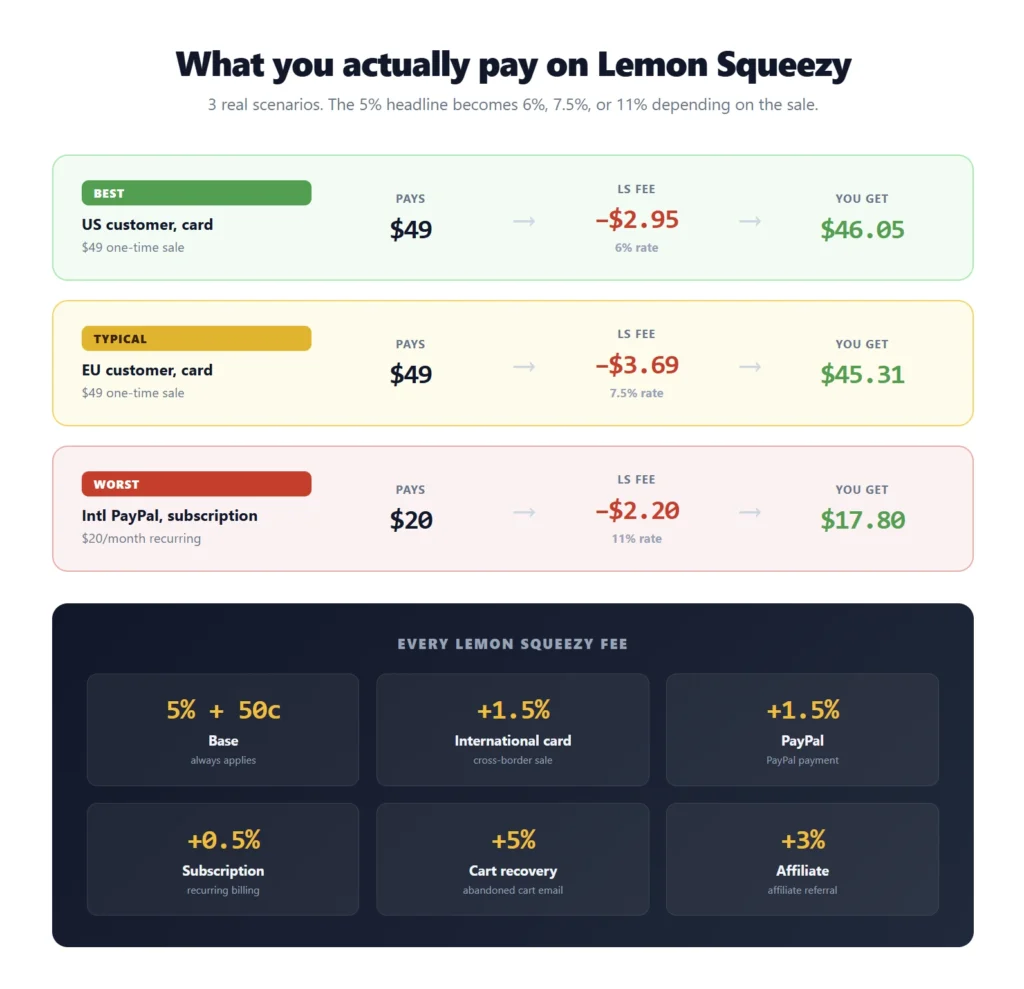
| Fee | When it applies |
|---|---|
| 5% + 50¢ | Base transaction fee. Always applies. |
| +1.5% | International cards (customer’s card is from a different country than your business) |
| +1.5% | PayPal payments (added on top of base) |
| +0.5% | Subscription/recurring payments |
| +5% | Sales recovered through abandoned cart email |
| +3% | Affiliate referrals (paid to the affiliate, not Lemon Squeezy) |
And separately, payout fees when Lemon Squeezy sends the money to you:
| Payout method | Fee |
|---|---|
| US bank transfer (Stripe) | Free |
| International bank transfer (Stripe) | 1% |
| US PayPal | $0.50 per payout |
| International PayPal | 3% (capped at $30 per payout) |
One nice thing: tax handling (VAT, GST, US sales tax across 80+ countries) is baked into the transaction fee. You don’t get billed extra for it, ever.
Real cost for different scenarios
Math doesn’t lie. Here’s what you actually pay on the kinds of sales WordPress sellers see every day. I’ve run these numbers for my own products, you can do the same for yours.
Scenario 1: US customer, $49 one-time product
- Customer pays $49 + any local sales tax (handled by LS)
- Base fee: 5% × $49 = $2.45
- Fixed fee: $0.50
- Total LS keeps: $2.95
- You receive: $46.05
This is as cheap as Lemon Squeezy gets. If most of your customers are in the US and you sell one-time products, this is what your fees look like.
Scenario 2: European customer, $49 one-time product
- Customer pays $49 + VAT (handled by LS)
- Base fee: 5% × $49 = $2.45
- Fixed fee: $0.50
- International card surcharge: 1.5% × $49 = $0.74
- Total LS keeps: $3.69
- You receive: $45.31
This is the most common reality for global digital sellers. Effective rate sits around 7.5%.
Scenario 3: International customer, $20/month subscription via PayPal
- Customer pays $20 + tax
- Base fee: 5% × $20 = $1.00
- Fixed fee: $0.50
- International surcharge: 1.5% × $20 = $0.30
- PayPal surcharge: 1.5% × $20 = $0.30
- Subscription surcharge: 0.5% × $20 = $0.10
- Total LS keeps: $2.20 per month
- You receive: $17.80 per month
That’s an 11% effective rate, basically the worst-case realistic scenario. Over a year that’s $26.40 in fees on a $240 subscription.
Scenario 4: Annual SaaS subscription, $99/year, US customer, card
- First payment: $99 + tax
- Base fee: 5% × $99 = $4.95
- Fixed fee: $0.50
- Subscription surcharge: 0.5% × $99 = $0.50
- Total LS keeps: $5.95
- You receive: $93.05
Effective rate around 6%. Each yearly renewal gets the same treatment.
Scenario 5: Lifetime product sold to international customer, $79
- Customer pays $79 + tax
- Base fee: 5% × $79 = $3.95
- Fixed fee: $0.50
- International card surcharge: 1.5% × $79 = $1.19
- Total LS keeps: $5.64
- You receive: $73.36
Effective rate around 7.1%. This is what most plugin and theme lifetime deals look like in practice.
Payout fees: the part most sellers miss
Here’s the part that catches people. The transaction fee comes out first. Then, when Lemon Squeezy sends what’s left to your bank account, there’s another small cut depending on where you live.
US bank account: zero payout fee. Lemon Squeezy pays out via Stripe for free.
Non-US bank account: 1% payout fee. For a developer based in India, the UK, Europe, or anywhere outside the US, every payout loses an extra 1%.
A monthly $5,000 payout to a non-US bank costs $50 per payout, or $600 per year. That’s not trivial.
If your bank account is in a non-USD currency (EUR, GBP, INR, etc.), the payout is converted at the mid-market exchange rate at the time of payout. Lemon Squeezy doesn’t add a hidden FX markup, but your local bank may.
US PayPal: flat $0.50 per payout. Cheap option for US-based sellers who prefer PayPal over a bank transfer.
International PayPal: 3% capped at $30 per payout. So a $1,000 payout costs $30. A $5,000 payout also costs $30. PayPal payouts make sense only for large amounts internationally.
One small thing that adds up: if you’re outside the US, set your payouts to monthly instead of weekly. Fewer payouts means fewer 1% fees getting applied. And stick to bank transfer unless you have a real reason to use PayPal.
How Lemon Squeezy compares to Stripe and others
Most people hear “5%” and immediately compare it to Stripe’s “2.9%”. Looks like LS is almost double, right? It’s not that simple. The two products do different things. Here’s the honest side-by-side.
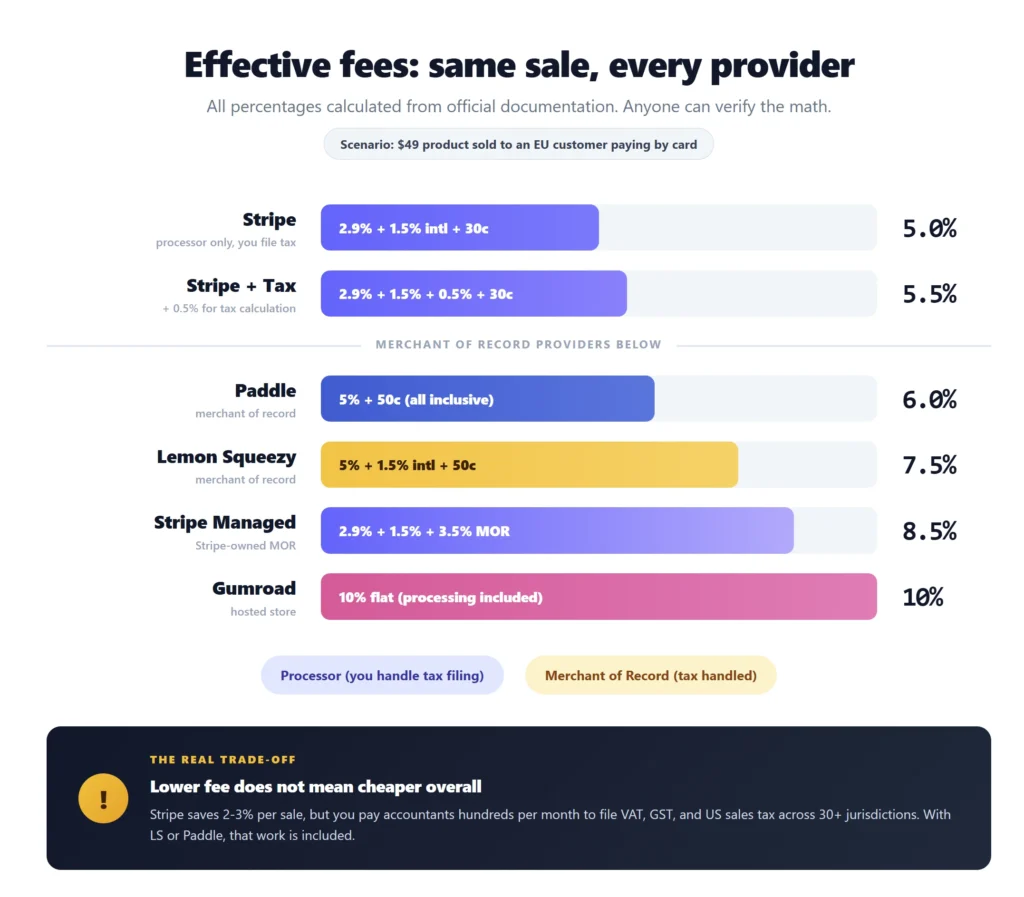
| Provider | Headline fee | What’s included |
|---|---|---|
| Stripe (default) | 2.9% + 30¢ | Payment processing only. You handle all tax, fraud, chargebacks, subscriptions, license keys yourself. |
| Stripe + Stripe Tax | 2.9% + 30¢ + 0.5% | Adds tax calculation. You still file and remit taxes yourself. |
| Stripe Managed Payments | ~6.4% domestic, 8-10% international | Stripe-owned merchant of record. Handles tax, fraud, disputes. New product. |
| Lemon Squeezy | 5% + 50¢ base, ~6-8% effective | Merchant of record. Handles tax in 80+ countries, subscriptions, license keys, fraud, dunning. |
| Paddle | 5% + 50¢ similar | Merchant of record. Similar to LS. |
| Gumroad | 10% flat | Hosted store + checkout. No WP integration. |
Comparing apples to apples (just the merchant of record options), LS sits in the middle. Cheaper than Stripe Managed Payments and Gumroad. Similar to Paddle. Yes, more expensive than plain Stripe, but Stripe leaves you to deal with global tax filings on your own. That’s not a small thing.
For a deeper comparison see our Lemon Squeezy vs Stripe on WordPress and Merchant of Record for WordPress guides.
When LS fees stop making sense
LS works great until you cross a certain revenue mark. Then the percentage starts hurting. Here’s how I’d think about it at each stage:
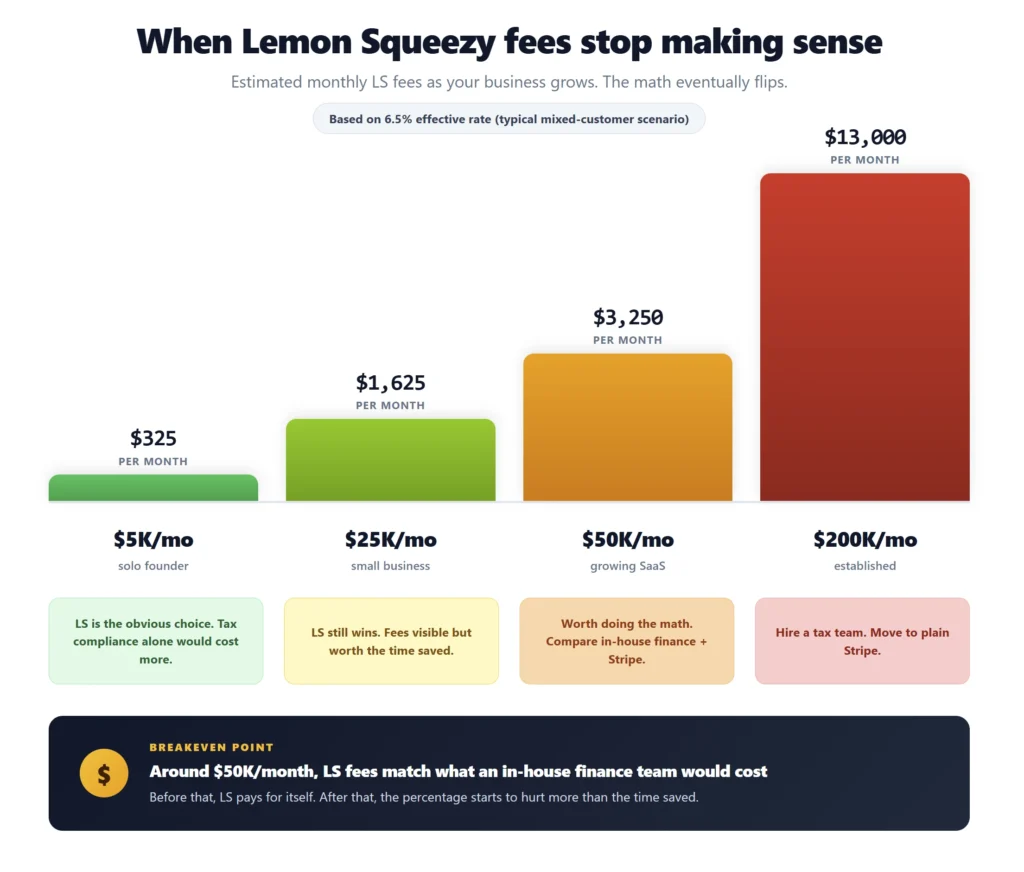
- Under $5,000/month. Stay on LS. The 2 to 3% extra you’d pay over plain Stripe is way less than what an accountant would charge you to file VAT, GST, and US sales tax in 30+ jurisdictions.
- $5,000 to $50,000/month. Still usually LS. You’re saving real time, and the fees are noticeable but bearable.
- Over $50,000/month. Time to do the math. At this size, hiring a part-time bookkeeper plus running Stripe directly might be cheaper. A lot of businesses migrate at this point.
- Over $200,000/month. Almost always cheaper to bring tax in-house and switch to plain Stripe. LS fees at this volume would be $10,000 to $20,000 a month.
LS is built for solo founders and small teams. As your business grows, the math eventually flips. Plan that migration before it’s urgent, not after.
Ways to actually pay less in LS fees
You can’t talk LS into a lower base rate. What you can do is set up your business so the optional surcharges hit you less often. A few things I’ve learned.
Push card over PayPal at checkout. Card fees are 1.5% lower than PayPal. Still offer PayPal if your customers want it, just don’t make it the default. Most people will pick whatever’s listed first.
Use bank payouts, skip PayPal payouts. Bank is 0% (US) or 1% (international). PayPal is 3% capped at $30. At any scale, bank wins.
Batch payouts if you’re outside the US. Default is more frequent payouts. Set it to monthly. Fewer payouts means fewer 1% fees getting applied.
Be careful with abandoned cart recovery if your prices are low. The 5% recovery fee chews up most of the recovered revenue on a $19 sale. On a $99 product, it makes total sense. On a $9 product, you’re paying LS to recover the sale for not much net gain.
Price in your customer’s currency when you can. Currency conversion isn’t an LS fee, but it does affect conversion rate. If your audience is mostly European and you price only in USD, you’ll see some abandonment that pricing in EUR would have caught.
Questions people keep asking me about LS fees
What does Lemon Squeezy actually charge per transaction?
5% + 50¢ is the floor. On top of that you’ll see +1.5% for international cards, +1.5% if the customer paid by PayPal, and +0.5% if it’s a subscription. In real-world numbers, most digital sellers end up paying between 5.5% and 8.5% depending on who their customers are.
Are there any monthly fees?
No. No monthly bill, no setup cost, no minimum revenue requirement. You pay only when you make a sale, plus a small fee when LS sends the money to you.
Lemon Squeezy is more expensive than Stripe, right?
On the transaction itself, yes. Stripe is 2.9% + 30¢. LS is 5% + 50¢. But Stripe doesn’t handle your taxes anywhere in the world. LS does. Once you factor in the accountant or compliance time you’d spend with Stripe, LS often comes out cheaper overall, especially if you sell internationally.
What happens if I refund a sale?
You give the customer their money back, but LS keeps the original transaction fee. So a refunded $49 sale costs you $49 plus the $3 or so LS already took. Chargebacks are worse: LS charges a $15 dispute fee on top of the refunded amount. They do handle the paperwork for you, which is something.
Do I pay extra for VAT or sales tax handling?
No. Tax in 80+ countries is included in the transaction fee. That’s the whole reason LS exists. You don’t register, file, or remit anywhere.
What’s the payout fee?
Free if you’re in the US and using bank transfer. 1% if your bank is outside the US. PayPal payouts are $0.50 flat (US) or 3% capped at $30 (international). The choice you make here matters more than people realize.
Why is my actual fee higher than 5%?
The surcharges stack. If a customer in France pays for a $20/month subscription via PayPal, you’re stacking +1.5% (international) + 1.5% (PayPal) + 0.5% (subscription) on top of the 5% base. That’s 8.5% + 50¢, not 5% + 50¢. Once you understand the rules, the number stops surprising you.
Is LS worth the fees if I’m just starting?
For me, yes. The extra 1 to 3% over plain Stripe buys you the global tax compliance that would otherwise cost hundreds per month in accountant fees, plus license key generation, subscription handling, dunning recovery, and fraud protection. Around $50K/month in revenue is where you’d start to think about migrating.
Putting it all together
Once you see all the fees laid out, LS pricing stops feeling mysterious. The base is 5% + 50¢. Stack 1.5% if the card is international, 1.5% if it’s PayPal, 0.5% if it’s a subscription, 5% if you recovered the sale through an abandoned cart email. On top of that, 1% payout fee if your bank is outside the US, or 3% capped at $30 if you take payouts via PayPal.
For most WordPress sellers I know, the real all-in cost lands somewhere between 5.5% and 7.5% of revenue. That’s what you pay to never deal with VAT registration, sales tax filings, license key infrastructure, dunning, or chargeback paperwork. To me, that trade has been worth it.
The day it stops being worth it is the day you grow past $50K a month. At that point, hiring a tax team starts making sense and plain Stripe gets cheaper overall. Until then, LS is a good deal for solo founders and small teams.
If you’re ready to start selling on Lemon Squeezy with WordPress, the setup guide walks you through it step by step. For everything our Lemon Squeezy plugin does (or the product page if you just want to buy it), the links are there.
Sources used to verify every fee in this article:
- Lemon Squeezy official fees documentation
- Lemon Squeezy getting paid (payouts) documentation
- Lemon Squeezy refunds and chargebacks documentation
- Lemon Squeezy affiliate fees documentation
- Lemon Squeezy pricing page
- Stripe pricing page
- Stripe Managed Payments product page
- Stripe Tax pricing page
- Paddle pricing page
- Gumroad pricing page