If you sell digital products from WordPress to customers around the world, you eventually run into this problem. A customer in Germany buys your online course. You need to charge them German VAT. A customer in California buys your design templates next week. Now you owe California sales tax. A few months later, a tax authority in the UK sends you a letter asking why you never registered for UK VAT on the 12 ebook sales you made there.
Welcome to the mess of international digital tax compliance. Every country, every state, every region has its own rules. Thresholds, registration, filings, returns, invoicing rules. If you’re a solo founder or a small team, it’s a full-time job just to stay compliant.
A merchant of record service solves this. In this article, I’ll explain what a merchant of record is in plain English, how it differs from a payment processor, why WordPress store owners selling digital goods benefit most from using one, and which MOR services work best with WordPress and WooCommerce in 2026.
This plugin adds Lemon Squeezy as a real WooCommerce payment gateway, so the merchant of record handles your sales tax and VAT while you sell from your own store.
No fluff. Just the real answer to a question a lot of WordPress sellers are asking right now.

What is a merchant of record?
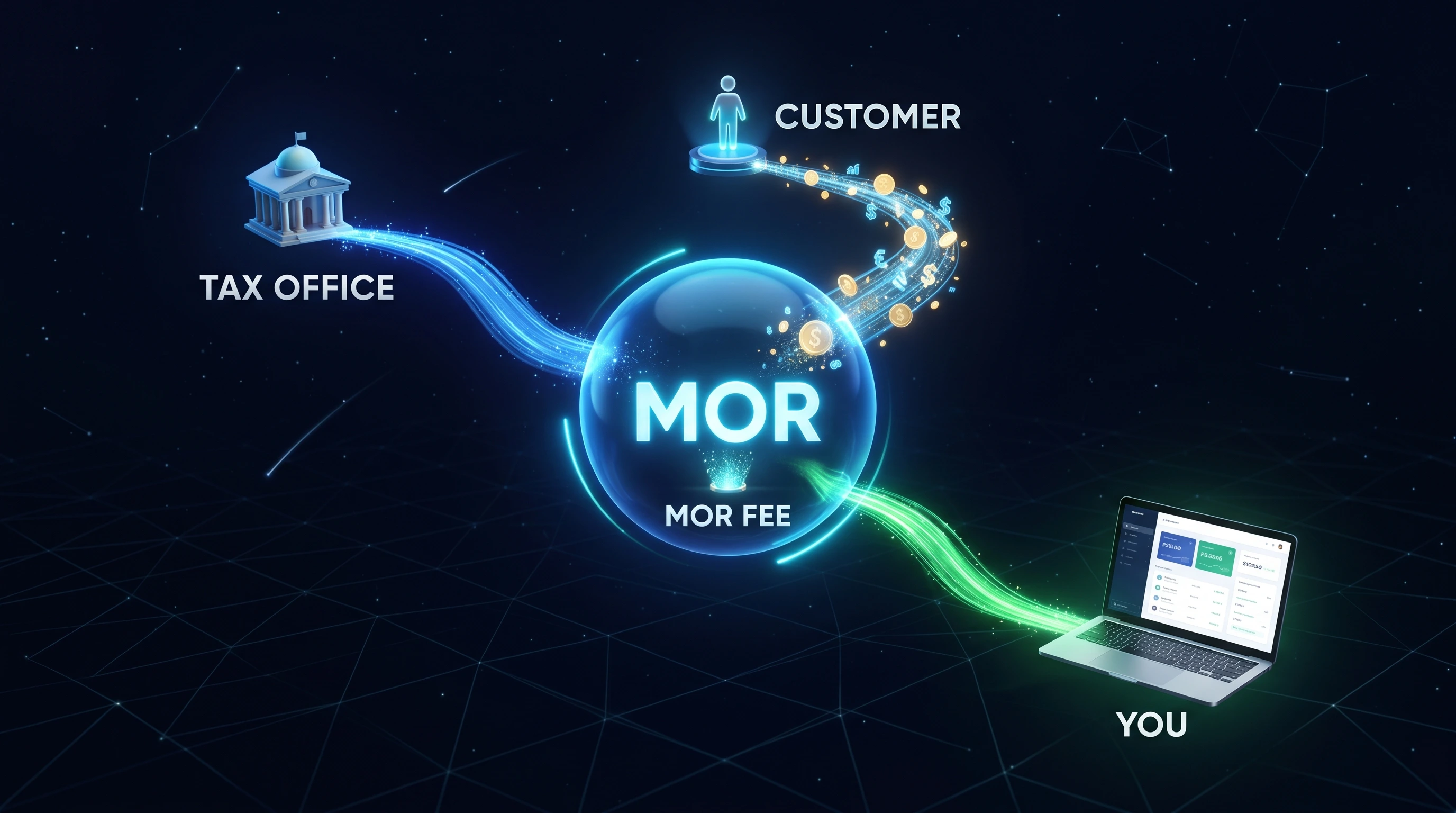
A merchant of record (often shortened to MOR) is the company legally responsible for selling a product to the end customer.
When a customer buys from a merchant of record:
- The merchant of record is who appears on the credit card statement
- The merchant of record collects the money
- The merchant of record handles all the tax (VAT, GST, sales tax) in every country
- The merchant of record deals with fraud, chargebacks, and customer support for billing
- After taxes and fees, the merchant of record pays you your share
You are technically a reseller through their platform. They own the customer transaction. You own the product.
A regular payment processor like Stripe or PayPal is different. When you use Stripe, you are the merchant of record. You own the transaction. You are responsible for tax compliance. You deal with chargebacks. Stripe just moves the money.
The difference matters a lot when you sell internationally.
Merchant of record vs seller of record vs payment facilitator
These three terms get confused all the time. Here’s the real difference in plain English.
Merchant of record (MOR) is the company that legally sells to the customer. Handles tax, compliance, refunds. Example: Lemon Squeezy, Paddle, FastSpring.
Seller of record is often used interchangeably with merchant of record, but technically refers to who appears as the seller on the invoice. In most cases, the MOR is also the seller of record. In some enterprise setups, they can be different.
Payment facilitator (or PayFac) is a company like Stripe or Square that handles card payments for many small businesses without each one needing a merchant account. The business (you) is still the merchant of record. The PayFac just simplifies the payment processing part. They don’t handle your taxes.
Easy way to remember:
- Payment facilitator = helps you take payments. You still handle taxes.
- Merchant of record = handles taxes too. They are the seller, not you.
Why a WordPress store needs an MOR (if you sell globally)
If you only sell to customers in one country, you probably don’t need a merchant of record. Your local sales tax is manageable.
If you sell digital products worldwide, the picture changes fast. Whether you sell courses, plugins, themes, templates, stock photos, ebooks, software licenses, music samples, SaaS subscriptions, memberships, or video tutorials, the tax rules hit you the same way. Here’s what a small digital product seller typically has to deal with:
- EU VAT (European Union). Every digital sale to EU consumers requires VAT to be charged at the buyer’s local rate, registered somewhere, and remitted quarterly. There are 27 countries, each with different rates.
- UK VAT. Similar to EU but separate since Brexit.
- GST in Canada, Australia, New Zealand, Singapore, India. Each country has its own digital goods rules.
- US sales tax. 45 states collect sales tax on digital goods. Each state has different thresholds for when you need to register (typically $100,000 in sales or 200 transactions).
- Norway, Switzerland, South Africa, Russia, Japan, South Korea. All have their own digital tax rules now.
As a small seller, registering for and filing taxes in 30+ jurisdictions is impossible. Most people either:
- Ignore it and hope nobody notices (risky, tax authorities are catching up)
- Pay an accountant $500 to $2,000 per month to handle it all
- Use a merchant of record service
Option 3 is what most small digital product sellers end up doing. The MOR charges a higher fee (usually 5% to 7% vs Stripe’s 2.9%), but they handle all the tax headaches. For a solo founder or small team, it’s often worth the extra 2% to 4% to avoid the stress and cost of global tax compliance.
What an MOR actually does for you
Beyond just payment processing, a merchant of record typically handles:
Tax calculation and collection. The MOR calculates the right VAT, GST, or sales tax based on the customer’s location and charges them at checkout. No work on your end.
Tax remittance. The MOR files tax returns and pays the taxes in every country. You don’t register anywhere. You don’t file anything.
Invoicing. The MOR issues proper tax invoices to customers, compliant with the rules in their country.
Fraud protection. The MOR absorbs the risk of chargebacks and fraud. You don’t lose money when a stolen card is used.
Subscription management. Most MORs handle recurring billing, failed payments, retries (dunning), and cancellations.
Currency conversion. Customers pay in their local currency. You get paid in yours.
Regulatory compliance. PSD2 in Europe, 3DS verification, PCI compliance. All handled.
Refunds and disputes. They handle the refund process and dispute resolution.
You just build the product, set up a store, and let the MOR deal with the money and tax side.
Who needs a merchant of record and who doesn’t
You probably need an MOR if:
- You sell digital products like plugins, themes, SaaS, online courses, ebooks, templates, stock photos, fonts, icons, Notion templates, Figma files, design assets, software licenses, memberships, premium tutorials, audio samples, or video content
- You sell to customers in multiple countries
- You are a solo founder, creator, or small team without a tax/finance department
- You want to sell subscriptions without building billing infrastructure
- Your total revenue is less than a few million per year
You probably don’t need an MOR if:
- You sell only to customers in one country and have the tax situation handled
- You sell physical goods (most MORs focus on digital only)
- You run a large business with an in-house finance and tax team
- You need full control over checkout branding and customer data
- You want the lowest possible transaction fees
Most WordPress creators fit the first group, whether you sell plugins, themes, online courses, ebooks, digital templates, stock photos, SaaS subscriptions, memberships, or software licenses. That’s why Lemon Squeezy, Paddle, and similar MORs are so popular in this space.

How an MOR handles taxes (the real story)
Here’s what actually happens when a customer buys from your WordPress store through a merchant of record.
Customer in Germany adds your course / ebook / plugin / template to cart
          ↓
Checkout detects their country
          ↓
Merchant of record adds German VAT (19%)
          ↓
Customer pays (including VAT)
          ↓
MOR collects the full amount
          ↓
MOR files and pays German VAT directly to German tax authorities
          ↓
MOR keeps their fee (e.g. 5% + $0.50)
          ↓
MOR pays you the rest as one payout
          ↓
You report your MOR payout as normal income on your country's taxes
You never touch German VAT. You never register in Germany. You never file a German tax return. The MOR does it all.
At tax time, you only owe income tax to your own country on the net amount the MOR paid you. Much simpler.
Best merchant of record services for WordPress in 2026
There are several merchant of record options. Here are the main ones that work well with WordPress and WooCommerce.
1. Lemon Squeezy

Best for: creators and small digital product sellers. Works well for courses, plugins, themes, ebooks, templates, design assets, SaaS subscriptions, memberships, software licenses, and most digital download types.
Fees: 5% + $0.50 per transaction.
WordPress integration: Lemon Squeezy has a standalone WordPress plugin that works separately from WooCommerce. For WooCommerce stores, the Lemon Squeezy for WooCommerce plugin from DevTonic Studios is the cleanest option. It adds Lemon Squeezy as a payment gateway inside WooCommerce, handles subscriptions, license keys, refunds, and webhook auto-setup.
Good for: clean integration with WooCommerce, license keys, subscriptions, overlay checkout.
Not great for: very high-volume stores (fees add up), physical goods.
2024 update: Stripe acquired Lemon Squeezy. They still operate as a separate merchant-of-record product in 2026.
2. Paddle

Best for: SaaS companies, medium to large digital businesses.
Fees: 5% + $0.50 per transaction (similar to Lemon Squeezy).
WordPress integration: Paddle has an API and webhooks. No first-party WooCommerce plugin. You’d need a third-party integration or custom development. Harder to set up than Lemon Squeezy for WordPress.
Good for: established SaaS businesses, sophisticated billing (usage-based, metered), custom integrations.
Not great for: smaller sellers who want plug-and-play WordPress integration.
3. FastSpring
Best for: software companies, B2B SaaS, established digital product businesses.
Fees: 5.9% + $0.95 per transaction (higher than Lemon Squeezy or Paddle).
WordPress integration: FastSpring has the Store Builder Library and embedded checkout. You can integrate with WordPress, but it requires more technical setup. Third-party WooCommerce plugins exist but are less polished.
Good for: businesses that want advanced tax handling, affiliate programs, multi-currency pricing.
Not great for: smaller sellers (fees are higher, setup is more complex).
4. Gumroad

Best for: creators, ebook authors, single-product sellers.
Fees: 10% per transaction (highest fees, but no monthly cost).
WordPress integration: Gumroad is primarily a standalone platform. Integrations with WordPress are usually via embed links or buttons, not full WooCommerce integration.
Good for: creators who just want to sell an ebook or course quickly without setting up a full store.
Not great for: WordPress-first businesses that want everything inside WooCommerce.
Honest recommendation
For most WordPress store owners selling digital products:
- Want clean WooCommerce integration, subscriptions, and license keys? Lemon Squeezy with our DevTonic plugin is the easiest path. Starts at $39 for the plugin plus Lemon Squeezy’s 5% fees.
- Running a larger SaaS business? Paddle is worth a look for more advanced billing features.
- Just want to sell one product quickly without WordPress complexity? Gumroad works but the 10% fee adds up.
- High-volume business with custom needs? FastSpring is more enterprise-friendly but costs more.
How to integrate an MOR with WordPress/WooCommerce

For Lemon Squeezy on WooCommerce, the setup is straightforward. Install a plugin, add your API key, link your products to Lemon Squeezy variants, and you’re done. The full step-by-step is in our Lemon Squeezy WordPress plugin setup guide.
For other MORs on WordPress:
- Paddle: usually custom API integration or a paid third-party plugin
- FastSpring: Store Builder Library embedded in your WordPress pages, or third-party plugin
- Gumroad: embed links/buttons from Gumroad into WordPress pages
Out of the box, none of them integrate as smoothly with WooCommerce as Lemon Squeezy does with the DevTonic plugin.
What it actually costs
Rough numbers based on a $49 digital product sale (course, ebook, plugin, theme, template, any digital good) to an EU customer:
| Service | What the customer pays | What you keep |
|---|---|---|
| Stripe (you handle tax) | $58.31 ($49 + 19% VAT) | ~$47.50 (after Stripe 2.9% + your tax filing costs) |
| Lemon Squeezy | $58.31 ($49 + 19% VAT) | ~$46.00 (after 5% + $0.50) |
| Paddle | $58.31 ($49 + 19% VAT) | ~$46.00 (after 5% + $0.50) |
| FastSpring | $58.31 ($49 + 19% VAT) | ~$44.80 (after 5.9% + $0.95) |
| Gumroad | $58.31 ($49 + 19% VAT) | ~$43.40 (after 10%) |
Stripe looks cheapest until you add your tax compliance costs. If you pay an accountant $500/month to handle global VAT, you’d need to sell 50+ products per month just to break even vs Lemon Squeezy. For most solo creators and small digital product sellers, the MOR option wins on net profit after compliance work.
Frequently Asked Questions
What is the difference between a merchant of record and a payment processor?
A payment processor (like Stripe) just moves money between cards and your bank account. You remain legally responsible for tax compliance, refunds, and chargebacks. A merchant of record is the legal seller. They handle taxes in every country, manage refunds, and take on the legal liability of the sale. You get a simpler business and a higher fee.
Is Lemon Squeezy a merchant of record?
Yes. Lemon Squeezy operates as a merchant of record for digital product sellers. They handle VAT, GST, US sales tax, and other digital taxes in over 80 countries.
Is Stripe a merchant of record?
No. Stripe is a payment processor and PayFac. You remain the merchant of record when using Stripe. Stripe does offer a product called “Stripe Tax” that helps with tax calculation, but you still file and remit the taxes yourself.
Do I need to register for VAT if I use a merchant of record?
Usually no. Because the MOR is legally the seller, they handle VAT registration and remittance. You only pay income tax in your own country on the net payout the MOR sends you.
Can I switch from Stripe to a merchant of record later?
Yes. Many WordPress store owners start with Stripe, hit EU VAT complexity, then switch to a merchant of record. Subscription migrations can be tricky (you usually can’t transfer existing subscriptions without asking customers to re-subscribe), so it’s easier to switch before you have a lot of active subscribers.
What are the downsides of using a merchant of record?
Three main ones: higher fees (5% to 10% vs Stripe’s 2.9%), less control over branding (some MORs show their name on the credit card statement), and less customer data access (the MOR owns the customer relationship legally, though they do share data with you).
Does the merchant of record work for physical products?
Most don’t. Lemon Squeezy, Paddle, and FastSpring focus on digital products, SaaS, and software. For physical goods, you typically stay with Stripe or a regional payment processor and handle your own tax compliance.
Is it legal to use a merchant of record?
Yes. Merchant of record is a well-established business model used by companies of all sizes. It’s legal in every country where the MOR operates. Always read the MOR’s terms to understand what they take responsibility for and what you remain responsible for.
Wrap-up
A merchant of record is one of the simplest ways for a WordPress store owner selling digital products globally to eliminate 90% of their tax compliance work.
To pick the right MOR for your situation:
- If you use WooCommerce and want clean integration: Lemon Squeezy with a dedicated plugin. See our Lemon Squeezy WordPress plugin setup guide.
- If you run a larger SaaS business: Paddle offers more advanced billing features.
- If you just want to sell one or two products fast: Gumroad is easiest but the 10% fee adds up.
- If you have complex enterprise needs: FastSpring covers more edge cases but costs more.
For most WordPress store owners selling digital products, Lemon Squeezy integrated into WooCommerce is the most balanced option. Reasonable fees, native WooCommerce integration, subscriptions, license keys, and full tax compliance globally.
If you’re evaluating options or have questions about integrating an MOR with your WordPress store, email us at support@devtonicstudios.com.
This plugin adds Lemon Squeezy as a real WooCommerce payment gateway, so the merchant of record handles your sales tax and VAT while you sell from your own store.